Case study
See the curve before you commit.
The math describing how a drug builds up and washes out of the body has been published for decades. It just usually lives in journal papers, not in anything a person can use. This tool puts a pharmacokinetic model behind an interactive chart — change the plan, watch the curve.
- Product
- Tirzepatide PK Scheduler — a personal project
- Scope
- PK math engine, comparison UI, dose logging, self-hosted
- Stack
- React · TypeScript · Recharts · Express
- Fine print
- Educational tool — not medical advice, not a medical product
The problem: dosing decisions are made blind
Tirzepatide — like many long-half-life drugs — doesn't do anything intuitive between injections. Concentration climbs for a day and a half, decays for days, and stacks dose over dose for weeks before reaching steady state. Questions like "what actually happens if I stretch the interval from 7 days to 10?" have precise, computable answers. Nobody computes them.
So this does: a one-compartment pharmacokinetic model with first-order absorption, with parameters validated against the published literature, running live under a chart. Every dose you add or move recomputes the whole concentration curve by superposition, instantly.
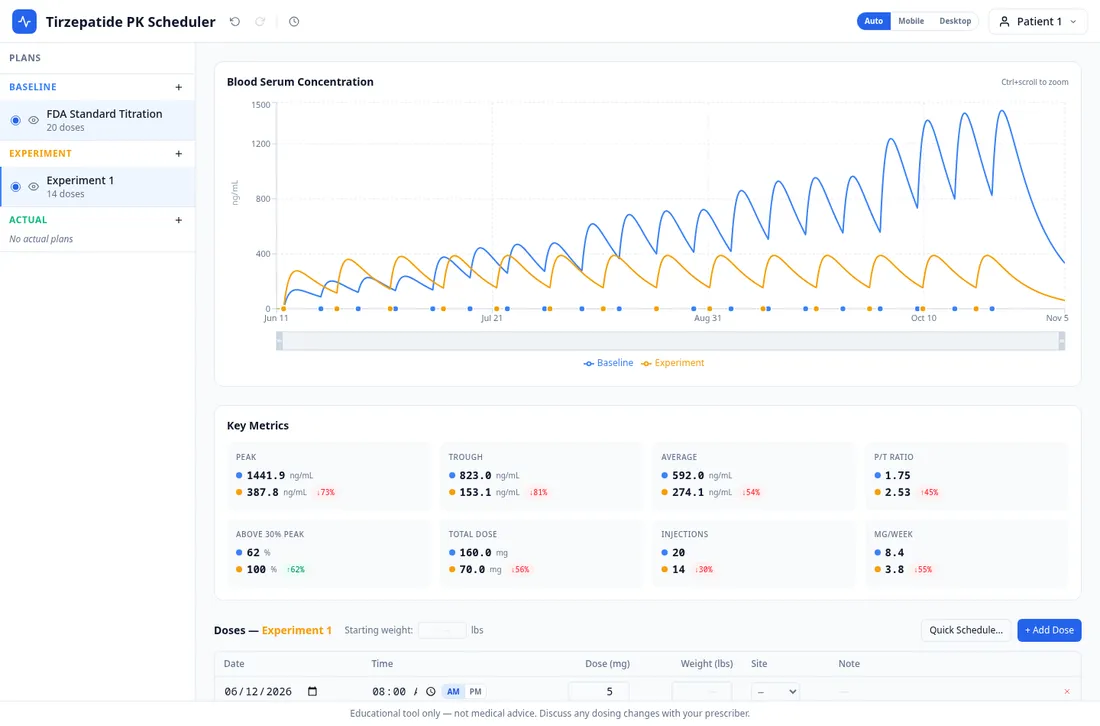
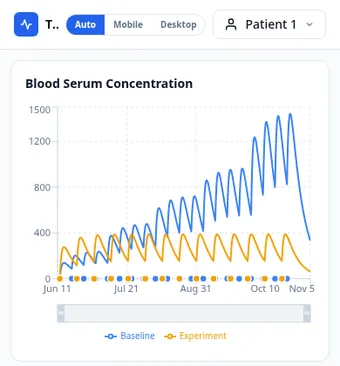
Baseline, experiment, actual
The design centers on comparison. A baseline plan — say, the FDA's standard titration schedule, available as a one-click template — sits next to an experiment: a different dose, a different interval, a skipped week. The chart overlays both curves, and the metrics panel scores the difference — peak, trough, average, peak-to-trough ratio, total milligrams — each with a percentage delta. What-if becomes a number instead of a guess.
A third plan type, actual, holds what really happened: logged doses, weights, injection sites, how the day felt. That turns the tool from a calculator into a record — plan against model, then check the model against life.
Built for personal use, self-hosted, and deliberately labeled: it's an educational tool, not medical advice. The engineering point stands on its own — published math, turned into something a person can hold.
Start your project